
“Tonight we’re not going to do any age jokes,” Mick Jagger said as he walked onto the Desert Trip stage alongside his Rolling Stones bandmates. “But welcome to the Palm Spring retirement home for genteel English musicians.”
The legendary rockers were bringing a showstopping end to the first night of the Desert Trip festival, which has taken place this week in California, organised by the same team behind Coachella. Bob Dylan played before the Stones, and over the next two nights Paul McCartney, Neil Young, The Who and Roger Waters would all also perform.
Dubbed “Oldchella”, it is almost definitely the last chance to see some of the most significant and defining artists of the last five decades, the Desert Trip offered a remedy to the rough year for deaths in the arts that 2016 has inflicted, which has undoubtedly led to serious thinking about musical mortality.
After the year had already started off on a bad foot with Motorhead’s Lemmy passing away at the end of 2015, in early January, David Bowie’s death caused the world to grind to a standstill. Since then, news of cultural and much loved icons passing away have kept on coming. Prince, Glenn Frey, Alan Rickman, and Phife Dawg just some of the more notable names that have reminded us of how temporary life can be.
Icons who we have all grown up watching and listening to, can’t and won’t last forever. So with that in mind it is easy to understand why an event such as Desert Trip, featuring a stable of 60’s music legends all in one place, appealed to so many. It offered a chance to see the undisputed greats of the last five decades across one extravagant event, the likes of which will probably never be seen again.
https://www.youtube.com/watch?v=wtGQfzDbEGY
It’s fair to say that the founder and producer of the Coachella and Desert Trip festivals, Paul Tollett, has had a fair old year. Already responsible for reuniting the classic Guns N’ Roses line-up at this year’s Coachella festival, Tollet wasn’t done with just yet.
The idea first came to him in May last year, but it wasn’t until he had watched each respective act live again that it really started to gain momentum in his mind. What if he could put together the greatest rock and roll line-up ever assembled and combine it with a festival experience like no other?
Joining The Rolling Stones, Bob Dylan, Paul McCartney, Neil Young, the Who and Roger Waters together to do this became closer to reality when Tollet actually gained a permit for two weekends at the Empire Polo Club in Indio, California.
Convinced that these six pioneering and legendary acts had the capabilities and followings in order to attract an audience demographic unlike anything witnessed before, the job then became about locking down the artists. With a rumoured talent and production budget of around $100M- the financial aspects of it were already extraordinary.
“I was in slow talks with each of the six,” Tollet explained to Billboard. “Once the specific concept was confirmed, I sent a financial offer out with a short window to accept.”
He billed it as one of the greatest shows of all time and after some initial trepidation from the artists involved all six of his targets signed on.
“A couple of them asked, ‘What are you going to do if we don’t do it?’ [I said] ‘If we don’t get these six, we’re not going to do the show.’”
Over the years, Coachella has become the prominent festival on the American music calendar. A success story that has made eye-wateringly high amounts of money in all of its recent showings. Just take last year for example, when it raked in over $84M in profit. Or in 2014, when it made $78M.
Latching onto the festival’s mass appeal and popularity, promoter Goldenvoice noticed a glaring gap in the market though which wasn’t being attended to. While festivals nowadays are catering to the youth of the day, there were none that were being constructed around the tastes of older generations, like the baby boomers. Yet this was essentially an untapped market full of disposable incomes, who were willing to spend a bit more money if what was on offer was deemed as worth it. Add to that the context in which so many musical greats have passed away, the timing couldn’t have been better.
The three day event spanning across the weekend promised to fix this, with a festival which offered not only great music but also the chance of recapturing youth. The Desert Trip was rooted firmly in nostalgia, but it needed to offer more than just that if it was to be classed as a success.
https://www.youtube.com/watch?v=rQEu65sZEP0
When news broke of its happening in early May, the fan response was unequivocal. Tickets for the first weekend sold out in just three hours. While amongst the mad scramble, it was decided by Goldenvoice that they would do a second weekend which they had initially remained silent about when tickets first went on sale.
“We were on the fence about a second weekend right up until the day we announced and saw the reaction,” Tollet said. “It generated four times the traffic of a typical Coachella announcement.”
The sense of being there at a significant cultural moment in music history weighed heavily as a drawcard for people who dashed to buy tickets.
“The audience is going to feel real special about being able to see all of this at once. It’s a celebration,” Neil Young declared.
Meanwhile, Gary Bongiovanni of Pollster magazine described it as a game-changing approach to festival creating.
“The event is expanding the boundaries of what a concert can be. This is a new concept and is aimed at a much different audience,” he said.
Alongside the two concerts performed each evening, there was also a wealth of other activities to do within the festival grounds. It appealed purposely to a mass selection of people looking for something more than just camping in mud and listening to music all day.
Clearly catering to an older and more comfort-driven audience, a “culinary experience” was offered with 40 of the country’s best chefs descending into Indio, California to serve up cooking classes as well as food. Luxurious RV camping packages were available as opposed to the old trusty tent. While there were free shuttle rides to the grocery stores nearby, before an afternoon of pampering at the “Beauty Bar” or a browse around arts and crafts stalls beckoned. More than just a music show, Desert Trip was packaged as a sort of all-inclusive weekend vacation. However, despite having so much variables to offer, the festival would have failed without the strength of its line-up.
“All the bands you’re seeing here have been playing music for 50 years or more,” Jagger told the crowd during last Friday’s set. “We think it’s pretty amazing you still want to see us, so thank you.”
The fact that all six acts are still highly regarded after such a long time in the industry is testament to not only their enduring appeal but also their talent. It comes as no real surprise that so many people still want to watch Jagger theatrically bounce around the stage like he’s still in his 20’s. Or Bob Dylan while he refuses to let his face be put up on the big screens as he strums through Like A Rolling Stone, one of the many songs which have just earned him a Nobel Prize in Literature.
At a time where many are mourning the loss of Bowie, Prince and others, this festival catered to an audience who not only wanted to take a journey back in time, but a chance to see artists who, quite seriously, may not all be around for decades to come. It acts as a reminder of the fragility of human existence but while also being a joyful celebration of the past and present.
Image: Billboard
Bob Dylan has just won the Nobel Prize for Literature, one of, if not the most coveted literary prize in the world.
The award was presented to the 75-year-old artist “for having created new poetic expressions within the great American song tradition.”
An extremely influential and culturally significant figure throughout the 1960s, 1970s and beyond, his music has gone on to form one of the most important canonical catalogues in music history.
It’s remarkable that a musician and poet, not an author, per se, has taken home this revered prize. Then again, Bob Dylan can easily be classified a poet first and musician second.
At the ceremony, Secretary of the Swedish Academy Sara Danils has described Dylan as “A great sampler … and for 54 years he has been at it, reinventing himself.”
Speaking about Blonde on Blonde, she described it as an “Extraordinary example of his brilliant way of rhyming. Putting together refrains, and his brilliant way of thinking.”
“If you look far back, 5000 years, you discover Homer and Sappho. They wrote poetic texts which were meant to be performed, and it’s the same way for Bob Dylan. We still read Homer and Sappho, and we enjoy it.”
https://www.youtube.com/watch?v=MGxjIBEZvx0
The 2015 Nobel Prize for Literature was awarded to Russian writer Svetlana Alexievich, “for her polyphonic writings, a monument to suffering and courage in our time.”
In addition to being awarded this tremendous accolade, Dylan has also just performed at “Oldchella,” or Desert Trip, a nostalgic three-day festival arranged by the team behind Coachella. Alongside Bob Dylan have been performances from The Rolling Stones, Neil Young, Roger Waters, Paul McCartney and The Who.
Read more: Flashback Friday: Bob Dylan, Blonde on Blonde
Image: Michael Ochs Archives
In one of the most unlikely pairings in, well, ever, experimental four-piece Animal Collective have shared a new remix today of none other than Bob Dylan‘s quaint, carefree tune Don’t Think Twice, It’s Alright.
Subtle and gentle and totally unlike the erratic insanity of their latest album, Painting With, Animal Collective provide a delicate touch to Dylan’s song. Having been a Dylan fan for most of my life, I am always skeptical of those who try to take on the man and his work in an attempt to put their own spin on it, so I was pleasantly surprised with just how well it worked.
Bird calls and watery, bubbling synths babble below Dylan’s twang. The synths layer upon each other, gentle and restrained as Animal Collective (in particular, members Geologist and Deakin – the two who made the remix) let a little bit out at a time. Instead of a full on aural assault, this remix is actually quite beautiful. Dylan’s lyrics reaffirming lyrics that “It’s alright” are given an almost pretty soundtrack as it slowly snowballs into a percussive, swimming dream before it fades away to some simple static and intermittent bird calls.
The release comes after Bob Dylan’s 75th birthday this week, and is a fitting tribute for one of music’s most influential and loved figures. Although I’m not totally convinced that Bob would enjoy this take, I certainly do and find it a fitting tribute indeed.
See More: Read our retrospective feature on Bob Dylan’s “Blonde on Blonde”
Image: Fact
Money makes people do weird things. Like, really weird. Celebrity endorsements come to mind as the birthplace of some of the more batshit insane advertisements that have seen the light of day. Following on from the announcement that Soulja Boy just signed a $400 million contract with an online poker fund, we’ve put together five of the craziest and hilarious musician endorsement deals. A word of warning, don’t read this article while you’re at work, because some are too ridiculous to contain your laughter and/or incredulity. Also there’s a Victoria Secret ad, and it’s really creepy.
Method Man x Sour Patch Kids
Yes, this happened. Method Man, formerly of the legendary Wu-Tang Clan, not only appeared in a 4-minute commercial for the candy company, but also wrote a rap for the sweets. The video opens hilariously with a parental caution screen, claiming that it “May contain content inappropriate for children.” Yeah, like extreme amounts of sugar. Also the lyric “pussy pump,” bleeped out in the final edit. Watch it below, and ponder how far the poor man has fallen. This is the same man who got a solo track on Enter The Wu-Tang (36 Chambers), and who The Source named in their list of 50 top lyricists.
https://www.youtube.com/watch?v=tw7uhVtpI5I
Snoop Dogg x Norton Anti-Virus
This one isn’t a video or an ad, but rather a campaign. Snoop Dogg legitimately teamed up with Norton Anti-Virus to hold the “Hack Is Wack” contest, where contestants were to create the best 2-minute rap song about “viruses, phishing attacks, identity theft and other cybercrime.” The prize? A ticket to L.A. to see a Snoop Dogg concert. Yes, this really, really happened.

(Image: Financial Spots)
Warren G x AffirmXL
Dick pills. Warren G, west-coast rapper/producer and stepbrother to Dr. Dre, starred in a commercial for dick pills. The same Warren G who was nominated for two Grammy’s, and here he is sitting on the toilet in some random guy’s apartment, reading a newspaper and handing him Viagra knockoffs. And you bet your ass he makes a Regulate joke.
https://www.youtube.com/watch?v=NLkOxdG6I2g
Bob Dylan x Victoria’s Secret
This one is less weird than the others, but way more creepy. Of all the people you wouldn’t want to see in a lingerie commercial, wrinkly old Bob Dylan is up there. His pouty/brooding expression rivals that of Jon Snow, but Snow is a) much more attractive than Dylan, and b) hardly ever surrounded by super models in their undies. Bob, you have no right to be all pouty, and you definitely have no place in this super creepy ad. He looks like a homeless man who wandered onto the shoot.
https://www.youtube.com/watch?v=QsFrFQ-F64Y
Ozzy Osbourne x I Can’t Believe It’s Not Butter
30 seconds. That’s all this commercial is, and it’s changed my life. I have no words, so please, just watch it.
https://www.youtube.com/watch?v=uMs7-MQb5as
I don’t know what’s better, the completely wooden line of, “Awh ah cahn’t tell the diffrence,” or the fact that he cracks an egg on a mini skull. This whole clip is so “…What the fuck?,” it’s better than most modern art pieces. I want this video to play at my funeral.
Image: Mental Floss
The words “break-up album” hold a lot of currency in the world of pop music, but Bob Dylan‘s Blonde on Blonde tells more. It’s romance in its entirety: the giddy heights, the downs and all the ephemeral moments in-between. It draws the listener into an illusionary world where there’s heartbreak, longing, lust and love lurking in every corner.
An undeniable fixation upon romance courses through the album. Surreal and effortlessly cool, it blends bluesy rock sounds with Dylan’s idiosyncratic vocal delivery. Some writers argue that lyrics, while just as meaningful, aren’t poetry in a true sense. If this is so, Dylan is the living exception. The songwriter crams his lyrics with detailed observations while somehow marrying them to melody. Yet unlike letters on a page, there’s also an intimate emotional connection that travels beyond words. Dylan’s music isn’t just heard, it’s felt.
However, to become the elder statesman of rock, Blonde’s Dylan is youthful and impetuous, albeit a little world weary. Paired with his self-titled debut in 1962, Blonde bookends the artist’s meteoric rise to stardom and precedes his mysterious retreat from the public eye two months after the album’s release. Disappearing at his creative peak, the same artist or momentum never truly emerged.
With Blonde, Dylan comes to fully inhabit the jive talking beat junkie, the romantic poet and rock star persona he cultivated with Bringing It All Back Home and Highway 61 Revisited . But it’s by no means an obvious continuation. The album exists in a self-contained world, a standalone statement.
Released May 16, 1966 (although some accounts differ), Blonde on Blonde is an album born of immense pressure. Moving towards the recording sessions, Bob Dylan fans were hungry for new music and subcultural acolytes were readying themselves for messianic revelations. The genesis of the album lays in ideas scrawled within in stolen moments secreted away from a whirlwind of touring commitments, publicity and fan mania. It’s easy to imagine Dylan penning ideas late night in muddled hotel rooms. There’s a cramped sense of atmosphere and an aching feeling of exhaustion that bleeds through from the album’s densely lyrical compositions.
Work began with a lengthy and mostly abortive attempt at recording in New York late in 1965. Retaining only Most Likely You Go Your Way (And I’ll Go Mine) as a finished cut, Dylan relocated to CBS’s Nashville studios in January the following year. Within this new environment, the singer’s scattered ideas were painstakingly repurposed and reimagined. Joined by a portion of his New York entourage, Dylan merged his existing sound with the effortless musical acumen of veteran Nashville session musicians. The end result was a formidable double album, the essence which could never be recreated, although even Dylan himself would later try with Street Legal. It’s perhaps Dylan’s own description that sums the album up like no other can: “The closest I ever got to the sound I hear in my mind was on individual bands in the Blonde on Blonde album. It’s that thin, that wild mercury sound.”
Robert Shelton in his seminal Dylan biography No Direction Home describes Blonde as beginning with a joke and ending with a hymn. The joke is Rainy Day Women #12 & 35. In a world of bi-yearly EPs, teasers, viral marketing and advanced reviews, it’s hard to imagine the impact of Rainy Day Woman #12 and 35. But travel back five decades and inhabit the mind of that diehard Dylan fan. Rushing home from the store, anticipation runs across your thoughts. Your mind flushes with relish for that moment the pin hits the vinyl. Cue wonky marching drums and the demented instrumentation that follows. Dylan knows how to make an entry.
The unconventional track’s semi-live sound plays with expectations. Characteristically abstract lyricisms mix with biblical scripture to form a slow marching subcultural mantra. “Everybody must get stoned,” Dylan giggles amidst the stomping revelry. “They’ll stone when you try to make a book,” he bemoans, slipping in an oblique reference to the poorly received manuscripts of his novel Tarantula.
Pledging My Time and Obviously 5 Believers continue the artist’s jangly blues-rock leanings. Dylan could always project a weathered voice and coarse gravitas beyond his years and these tracks prove no exception. Alongside Just Like A Women, Leopard-Skin Pill-Box Hat evokes an almost folkloric association with Dylan’s doomed flirtations with Factory girl Edie Sedgwick. The track spits forth venomous cultural commentary, perhaps revealing growing disenchantment and a desire to retreat from the world of celebrity. Temporary Like Achilles drags with constriction, gleefully savouring the failure of a relationship while goading another half to do better. The flirtatious shuffle Absolutely Sweet Marie pulses with energy, bristling with innuendo it serves up memorable Dylanism: “To live outside the law you must be honest.”
Third track Visions of Johanna stands out as a mercurial lyrical masterwork. Love is the central preoccupation. The longing melancholy of Visions was penned following Dylan and Joan Baez’s separation and hints at the latter’s icy dismissal. It’s hard to isolate when exactly Dylan sucks you in. Saturnine lyrics drip with longing, scratchy instrumentals follow a meandering tempo and a suffocating feeling of heartbreak leaks from the chords. The poetic leanings of Dylan’s lyricisms have seldom reached the level of resonance and intricacy they find in the narrative of Louise and Johanna.
Stuck Inside of Mobile with the Memphis Blues Again captures the spontaneity with which it was composed. While the biggest artists of the day retreated into the studio to create surrealistic productions which could never be created live, Dylan resisted the norm. Ad libs and a few mumbled lyrics add to the ragged charm. The track oscillates between a gamut of emotion; joyous glees, despair, and seething frustration. Strict literal interpretation yields nothing. Dylan conjures an absurdist narrative. But that’s his magic. Intonations, phrasing and animated sonic timbre, make it next to impossible not to picture vivid mental images. “Well, Shakespeare, he’s in the alley/With his pointed shoes and his bells/Speaking to some French girl/Who says she knows me well.” Behind the lyrics there must be a meaning or at least an idea. Bob Dylan knows it, but you’ll never understand it. Yet on reflection you can’t shake the impression that you’ve somehow met him halfway.
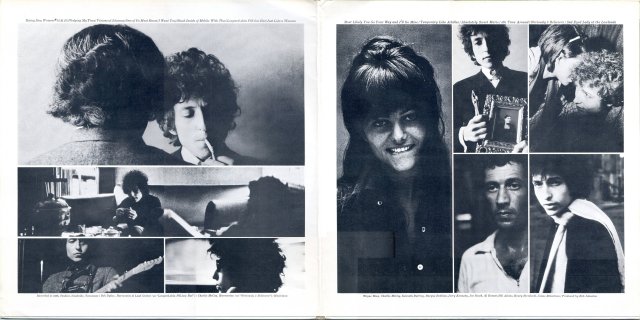
Blonde on Blonde’s inner sleeve, images by Jerry Schatzberg
Just Like A Woman is one of Dylan’s most divisive works, yet also one of his most commercially successful. Again, it chronicles the breakdown of a relationship. It exists in the irrational mind of a jaded lover. It’s the feeling, not the words, which make the song. A moment of self-righteousness and hubristic denial of self-loathing. It’s akin to blaming another when we will inevitably come to blame ourselves.
I Want You is the songwriter’s take on Top 40 pop. Bob Dylan raps the lyrics of a venomous yet devotional would-be lover. Thematically there’s an insistence and directness which marries perfectly with the on-the-nose nature of power pop. Despite its commercial leanings, the heartfelt narrative strikes a genuine chord.
When The Beatles released Nowhere Man in 1965 it’s ¾ timing, circular lyrical structure, and Lennon’s atypically confessional lyrics were noted as overtly Dylanesque. In Fourth Time Around, Bob returns the favour by adopting a style which mocks Fab Fours’ appropriation in turn. “I never asked for your crutch, now don’t ask for mine,” he levels.
Sad-Eyed Lady of the Lowlands reveals the writer’s total infatuation with new wife Sarah Lowlands. Blonde‘s devotional closing track paints a lyrical portrait of a women stepped in mysticism. Having discreetly married the previous year, Bob Dylan would remain with Lowlands until the pair divorced mid-1977. In Sara on 1975 album Desire, Dylan articulates that he authored Sad-Eyed Lady at the famed Chelsea Hotel. It’s hard not to zero in on lyrics, but the music which underscores the track is also remarkable. Hypnotically building over a minimalistic song structure, you can almost feel the anticipation of the studio musicians wondering if the next chorus will be the last. The track also serves as an antecedent to the heartbroken lyricisms of Desire and Blood on the Tracks over a decade later.
Blonde on Blonde captures Bob Dylan’s craft at one of its finest moments. Redefining the role of the singer-songwriter and the very fabric of popular culture with prophetic ease, the album serves to remind us why Dylan remains an exalted musical figure. Fans and critics may be divided over which (if any) of Dylan’s cuts is his best, but it wouldn’t be difficult to tender the idea Blonde on Blonde stands out as the greatest. Tramp, troubadour, and entertainer, the album showcases Bob Dylan at his best.
Image: Rolling Stone
Goldenvoice, the company behind Coachella and the new Panorama Music Festival in New York City have announced plans to arrange a super-festival of sorts. The event reads more like a best-of classic rock ‘n roll record collection than a lineup, and is sure to pull one hell of a crowd.
According to the Los Angeles Times, Goldenvoice are set to coordinate an event featuring Sir Paul McCartney, The Rolling Stones, Pink Floyd’s Roger Waters, The Who, Bob Dylan and Neil Young. If the event goes ahead, it will mark the first time that these legends have all been featured on a single event.
The event would no doubt be a once-in-a-lifetime experience (and with that I’m sure we can expect an equally monumental ticket price) and is set to take place from October 7 – 9 at the Empire Polo Field in Indio, California, with Dylan and the Stones headlining the Friday night, Young and McCartney on Saturday, with The Who and Waters closing the weekend on Sunday. Attendees can look forward to “full stage productions, with full sets,” which is a remarkable offer for a festival, which usually features strictly shortened setlists and minimal personalised stage production.
“It’s so special in so many ways.” said Young’s manager Elliot Robert. “You won’t get a chance to see a bill like this, perhaps ever again. It’s a show I look forward to more than any show in a long time.”
No further details are available, including whether other bands will play ahead of the mammoth headliners, all of whom are Rock ‘n Roll Hall of Fame inductees, or if it will essentially just be six concerts rolled into three huge days.
Personally, the most exciting thing about this announcement is dreaming about a Bonnaroo-style mega jam between these artists. It’s a ridiculous thought, but you never know, right?!
Look out for an official announcement from Goldenvoice across the next few weeks.
Image: Ha Aretz
A man has spent nearly five years trying to track down the location from the iconic Bob Dylan album cover Blonde on Blonde, and now he has finally found it.
In a detailed account at popspotsnyc.com, Bob Eagen has finally worked out the exact location of where the famous shot was taken. He reveals it to be located in Greenwich Village at 375 West Street at Morton Street, outside a building that has since been replaced with apartments.
The classic 1966 record, which was pretty much the first ever double album in music history, features Dylan on the front in a jacket and scarf, yet he is slightly out of focus, giving the shot a blurry aesthetic.
There have been numerous discussions over the years about the reasons behind the style of the shot, with many settling on it attempting to represent the drug fuelled haziness of the times. However, last year, the man behind the lens Jerry Schatzberg cleared it all up when he stated that the effect was actually just an accident and a consequence of the freezing cold temperatures outside.
In an interview with Bob Eagen, he explained, “It was pretty cold outside. It was February, [Dylan] was wearing just that jacket, and I was wearing something similar, and the two of us were really cold.”
During the same interview Schatzberg told of how the shot was one of numerous taken during the session, and said the setting was vaguely “the meat-packing district downtown [in New York].”
However, he insisted that the precise location would be close to impossible to find due to the general “gentrification” of the area. But now Eagen has finally located the setting from years of detailed researching and exploring.
Blonde on Blonde was Dylan’s seventh studio record and was recorded in New York during the middle of the 1960’s up until early in the year of 1966. It bookmarked a consecutive run of rock albums by the previously acoustically driven songwriter, initially started by 1965’s Bringing It All Back Home. It has been regularly revisited since its release and has been cited by critics and publications worldwide as one of the greatest albums ever recorded.
Watch an interview with Schatzberg about the shoot below:
https://www.youtube.com/watch?v=A3qXRfHIeuY
Image: Jerry Schatzberg
So here’s something you never thought you’d see… Taciturn sixties singer Bob Dylan covering Drake’s Hotline Bling is the sort of thing you might experience in a particularly strange dream, not coming out your TV screen. But that is exactly what happened on The Tonight Show with Jimmy Fallon.
[youtube https://www.youtube.com/watch?v=gc40zIaCw6U]
In an uncanny impersonation of the surly troubadour, Fallon performed the song in its entirety, set to instrumentals that perfectly reprised Dylan’s mid-sixties sound. Complete with harmonicas and piping organ, the song took on a melody suspiciously similar to Positively 4th Street. Fallon’s vocals are also a near perfect in their drawling croak and jumbled rhythms, transposing Drake’s own heartbreak to something near Dylan’s decades old pain.
Performing with his eyes shaded by a wide-brimmed hat, in a waistcoat and high-collared shirt, the image was pretty much complete, along with the requisite Fender Telecaster, and the hazy camera work. But what is also uncanny is how well Hotline Bling comes out in this style.
As one of the most parodied tracks from last year, Fallon’s rendition is definitely an odd concept, but perhaps the most flattering so far. Generally recognised as one of the geniuses of songwriting, transposing the track to sound credible out of “Dylan’s” mouth is a fair achievement (even if it does borrow quite a bit from one Bob wrote earlier). And hopefully this one might make Drake feel a little better about what we did with Hotline Bling and those dance moves.
Sorry Drake.
[youtube https://www.youtube.com/watch?v=3COEAIU7bE4]
Continuing his exhaustive Bootleg Series this November, Bob Dylan is set to release the latest instalment The Cutting Edge 1965–1966: The Bootleg Series Vol. 12 on the 6th of the month. Charting every single track recorded by Dylan over one of his most prolific periods, one which produced his famous Highway 61 Revisited and Blonde on Blonde, recordings include outtakes, rehearsals and alternates.
Volume 12 will be available on CD and vinyl, including as a massive Deluxe edition comprised of 18 discs. And which according to Dylan’s website, where the Deluxe edition will be exclusively available, “includes every note recorded in the studio during these renowned sessions”. A super fan’s dream, there is even an entire disc devoted to versions of his classic song Like A Rolling Stone.
Ahead of the full release, previously unheard recordings have been released. Including Can You Please Crawl Out Your Window?, It Takes A Lot To Laugh, It Takes A Train To Cry and Subterranean Homesick Blues. It is an interesting insight into the writing process, and one which few artists would probably be comfortable sharing. Previous Bootleg Series releases have included early demos of Subterranean Homesick Blues, but in this latest version Dylan has actually created a composite of three different takes. Listen below for the alternate version, understandably Bob hadn’t got those tongue twisting lyrics down quite yet!
[youtube http://www.youtube.com/watch?v=3EF1mDgfKKM]
[youtube http://www.youtube.com/watch?v=VuEmN1QoejU]
[youtube http://www.youtube.com/watch?v=2Mb3CoWwNyY]
Ultimate sixties counterculture icon Bob Dylan has lent his presence to the computing giant IBM, for an ad featuring the singer and a talking computer. It’s quite the feat considering the reclusive nature of Dylan. IBM premiered the ad during the highly prized Monday Night Football slot to maximise its audience. It’s one of three thirty second ads made to promote the product.
In the ad, Dylan walks into a library with guitar in hand and sits down in front of a computer. A seemingly self-aware computer called ‘Watson’ (actually IBM’s cognitive computing system) demonstrates its artificial intelligence by analysing the catalogue of Dylan’s songs.
“I can read 800 million pages per second. My analysis shows your major themes are time passes and love fades,” Watson tells Dylan.
“That sounds about right,” Dylan replies dryly.
The two even play around with idea of a collaboration, prompting Watson to sing a monotonous tune and allowing a less-than-impressed Dylan to make his departure.
The glib reading procures a decipherment of the lyrics rapidly. What fans have been trying to do for decades, Watson manages to achieve in a mere fraction of the time.
[youtube http://www.youtube.com/watch?v=pwh1INne97Q&w=560&h=315]
According to a spokesperson for IBM, the program did actually do a cross-analysis of all 320 of Dylan’s songs to come up with the trend of “time passes” and “love fades”.
This isn’t the first time Dylan has appeared in an ad. In 2004, he appeared in a commercial for Victoria’s Secret lingerie and in 2008 he did an ad for Cadillac. He teamed up with Chrysler and Chobani for commercials that aired during the the 2014 Super Bowl as well.